 |
Kai-Fu Yang (杨开富) |
About Me
I am an associate research professor at the MOE Key Lab for Neuroinformation, School of Life Science and Technology, University of Electronic Science and Technology of China (UESTC). I received my Ph.D. degree in Biomedical Engineering from UESTC in 2016 under the supervision of Prof. Yong-Jie Li. From August 2019 to August 2020, I was a visiting scholar at the Computer Vision Lab, Department of Information Technology and Electrical Engineering, ETH Zurich, Switzerland.
Research Interests
I conduct interdisciplinary research at the intersection of visual cognition and computer vision. My research aims to explore the underlying computational theory of visual cognition and develop bio-inspired methods for computer vision applications. Through a combination of computational modeling and behavioral experiments such as eye-tracking, we investigate the computational basis of many aspects of vision, including visual perception, active vision, and object recognition.
In addition, we also seek to develop novel artificial intelligence methods for healthcare and human-computer interaction, particularly based on eye-tracking technology and ophthalmic image analysis.
Projects and Publications
(1) | Visual Attention | Object Search | Active Vision |
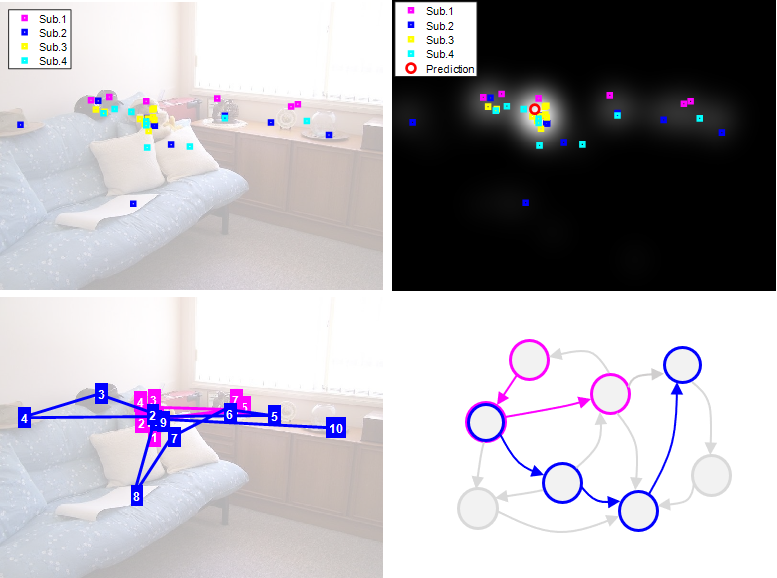 |
Visual Attention Graph We propose a new attention representation, called visual attention graph (VAG), to simultaneously code the visual saliency and scanpath in a graph-based representation and better reveal the common attention behavior of human observers. The visual attention graph provides a better benchmark for evaluating attention prediction methods and demonstrates promising potential in assessing human cognitive states. |
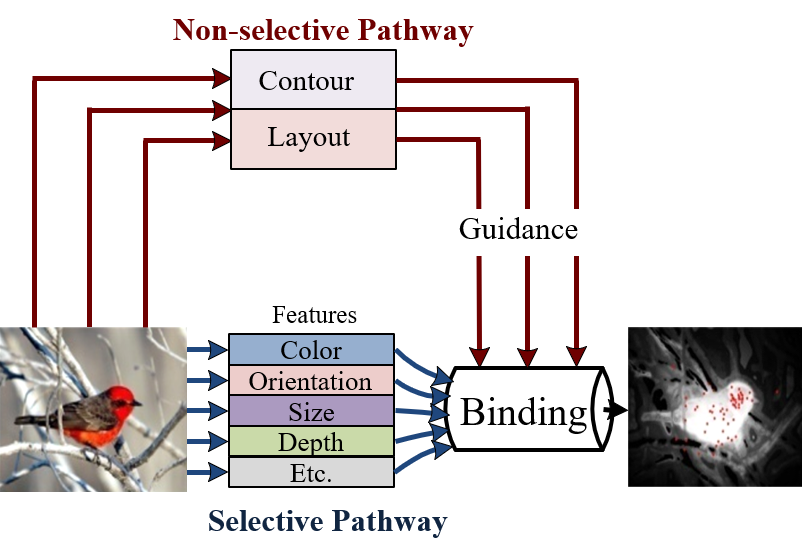 |
Guided Attention and Saliency Detection |
(2) | Lightness and Color | Receptive Field | Visual Enhancement |
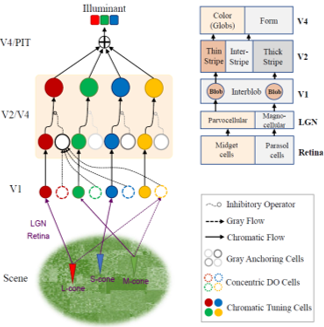 |
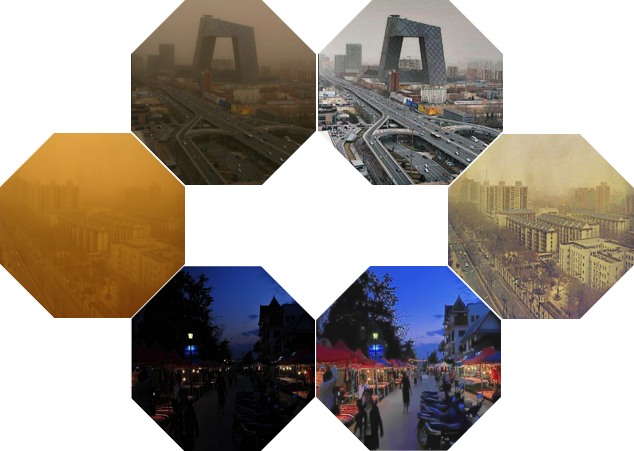
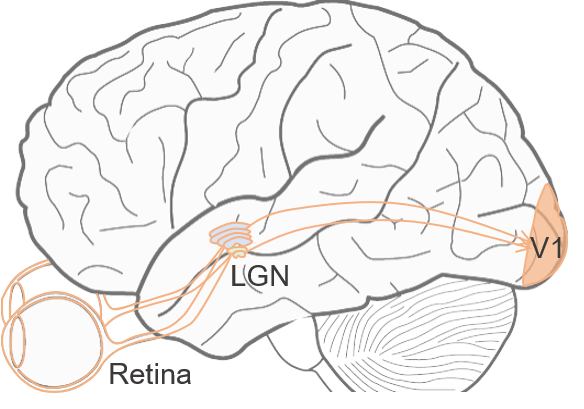
Gray Anchoring and Gray Pixel [Codes] We propose a novel computational theory—Gray Anchoring Theory—to explain how the early visual system contributes to color constancy, and we suggest that concentric double-opponent cells in V1 serve as the neural basis for implementing gray anchoring. Furthermore, we have systematically developed Gray-Pixel methods for illuminant estimation and established a complete technical framework for bio-inspired color constancy by integrating biological mechanisms, computational theories, and algorithmic implementations. We also defined the problem of nighttime color constancy (NCC) and collected the first NCC dataset. |
 |
Lightness and Image Enhancement |
 |
Contour Detection and Receptive Field Models [Codes] |
(3) | Eye Tracking | Ophthalmic Imaging | AI in Optometry |
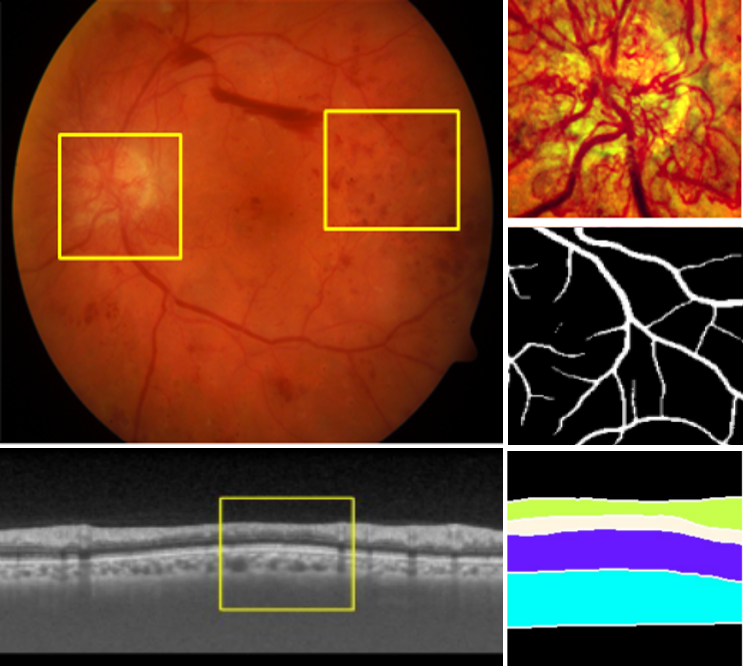 |
Ophthalmic Image Analysis |
Professional Activities
Associate Editor for IET Image Processing.
Reviewer for IJCV, IEEE T-IP, IEEE T-ITS, IEEE T-CSVT, etc.